
How to Get a Document Notarized in Canada
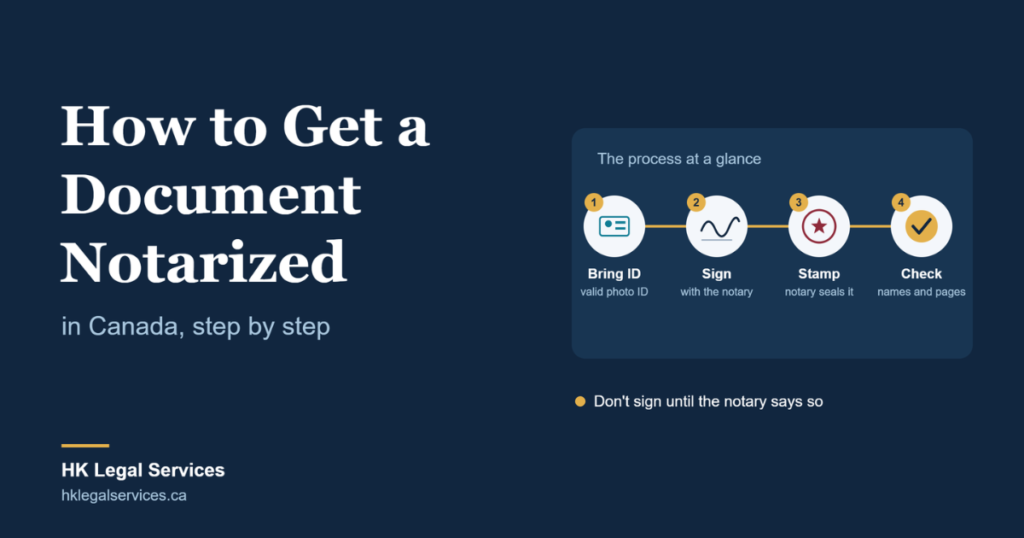
You’ve been told a document needs to be notarized, and you’re not sure where to start. Who do you go to? What do you bring? Do you sign first, or later? These are the questions we hear most, and the answers are simpler than they seem once you know the order of steps. This guide walks you through the whole process, from checking what the receiving office wants to what to do after you leave the notary’s office. It also covers the mistakes that cause most delays, so you can get it right the first time. The Short Answer: How Do You Get a Document Notarized in Canada? To get a document notarized in Canada, follow these steps: Fees and appointment availability vary by notary and province, but with the right preparation, most simple documents take under half an hour. Step 1: Confirm What the Receiving Party Actually Needs Before you book anything, find out what the person or organization asking for the document expects. “Notarized” can mean different things depending on the situation, and a quick check now can save you from doing it twice. Ask them: If you can, get their requirements in writing. It protects you if anything gets rejected later. Step 2: Identify the Type of Notarial Act You Need Notaries do a few different things, and knowing which one applies helps you prepare properly. In our guide on what a notary public does in Canada, we cover each in detail, but here’s the short version: Witnessing a signature. You sign a document in front of the notary, who confirms your identity and that you signed. Common for powers of attorney, consent letters and agreements. Administering an oath or declaration. You swear or affirm that the contents are true. Common for affidavits and statutory declarations. Certifying a copy. The notary compares a copy against your original and certifies it as a true copy. Common for passports, diplomas and ID documents. Each one has slightly different preparation. For a signature or oath, you bring an unsigned document. For a certified copy, you bring the original (and often a copy, though some notaries make it themselves). Step 3: Prepare Your Document A well-prepared document makes everything faster. Here’s what to do. Complete it, but don’t sign it. Fill in all the blanks, check names and dates, and make sure every page is there. The notary has to watch you sign, so leave the signature line empty. Use a clean, final version. Avoid correction fluid or handwritten changes. If something needs fixing, print a new copy. Check the details match your ID. Names, spellings and dates should match your government-issued ID. A small mismatch, such as a missing middle name, can cause delays or rejection. Bring all pages and attachments. If the document has exhibits or schedules, bring them in the right order. Notaries often need to see the whole document, and some will stamp every page or attach a certificate. Bring extra copies if you need them. Some people notarize two or three copies at once, especially for travel or applications that need originals in more than one place. Don’t staple or unstaple after notarization. Once a notary has stamped and assembled a document, changing the pages can invalidate it. If your document isn’t in English or French, tell the notary in advance. A notary generally has to understand what they’re notarizing, and many won’t certify something they can’t read. You may need a certified translation first. Step 4: Gather Valid ID Identity checks are the heart of notarization, so this step matters more than most people expect. Bring valid, government-issued photo ID. Common acceptable options include: The ID should be current. Expired ID is usually refused. If you’ve changed your name, bring supporting documents such as a marriage certificate or change-of-name certificate, and tell the notary ahead of time. Some notaries ask for a second piece of ID in certain situations, so it’s worth asking when you book. If the signer has no photo ID at all, the notary may have alternative procedures, but it’s up to them, and not all will proceed. Step 5: Find and Book an Authorized Notary Not every person with a stamp is authorized to notarize, so check before you book. In common-law provinces (such as Ontario, Alberta and Nova Scotia), notaries public are typically appointed or recognized by the province, and in many cases the notary is also a lawyer. In Ontario, for example, many notarizations are done by lawyers. You can learn more through your provincial law society, such as the Law Society of Ontario. In British Columbia, notaries public are a separate regulated profession, overseen by the Society of Notaries Public of BC. In Quebec, notaries are civil-law notaries regulated by the Chambre des notaires du Québec, and their role goes beyond what a common-law notary does. When you contact a notary, ask: Choosing someone with experience in your type of document makes a real difference. For example, a notary who regularly handles documents for use overseas will know what foreign offices expect. Our Notary Services team can review your document before the appointment so you know what to bring and what to expect. Step 6: Attend the Appointment Here’s what a typical appointment looks like. Be patient with the questions and checks. They’re not being difficult. Each step protects you and the document from fraud and later challenges. Special situations at the appointment: Step 7: Check the Notarized Document Before You Leave Don’t rush out the door. Take a minute to check: Fixing a mistake at the appointment takes seconds. Fixing it later can mean going back to the beginning. Step 8: Take Care of Next Steps Once the document is notarized, you may not be finished. If the document stays in Canada, you’re usually ready to submit it to the bank, court, school, employer or agency that asked for it. If the document is going to another country, you’ll likely need an apostille (for Hague Convention
What Does a Notary Public Do in Canada?
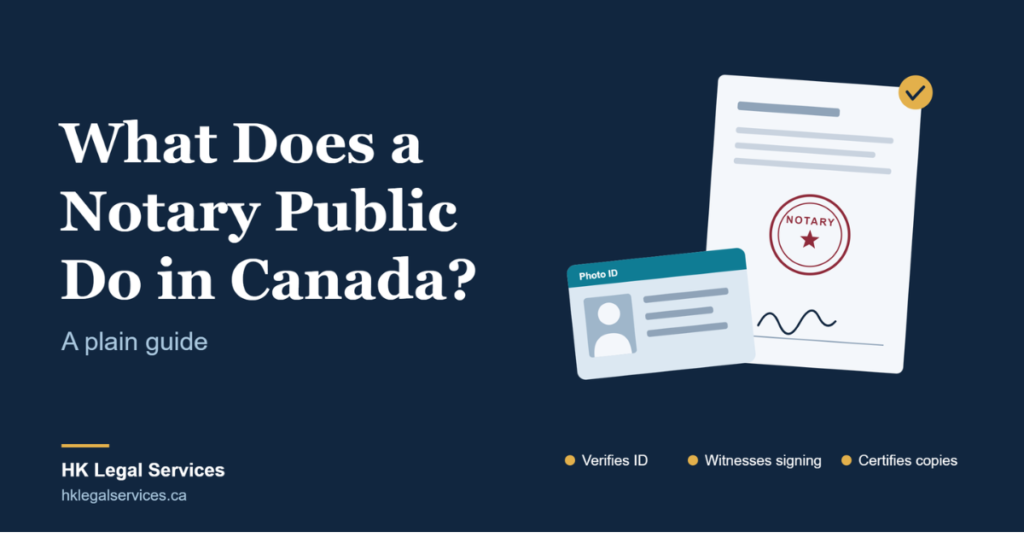
At some point, most people get asked for a notarized document. It might be a travel consent letter for your child, a power of attorney, an affidavit for an immigration application, or a certified copy of your passport. The request usually comes with a deadline, and no explanation of what a notary actually does. This guide explains it in plain language: what a notary public does in Canada, what they can’t do, how the role differs from province to province, and what to expect when you book an appointment. The Short Answer: What Does a Notary Public Do in Canada? A notary public is an official who acts as an impartial witness to important documents. In Canada, a notary public verifies your identity, witnesses your signature, administers oaths and declarations, and certifies copies of original documents as true copies. By doing this, they add a layer of trust, so that banks, courts, government offices and foreign authorities can rely on your document. A notary doesn’t confirm that the content of your document is true or legally sound. They confirm the signing process: who you are, that you signed willingly, and that the signing happened in front of them. What Is a Notary Public? A notary public is someone authorized by law to carry out certain official acts, called notarial acts. Think of them as a trusted neutral party. They have no stake in your document. Their job is to make sure the formalities were done properly. When a notary completes a notarial act, they usually sign the document, add their official stamp or seal, record the date and place, and in many cases write the details in a notarial register. That record is part of what makes notarization reliable. If anyone questions the document later, there’s a trail showing what happened. The Main Things a Notary Public Does 1. Verifies your identity Before anything else, the notary checks that you are who you say you are. That means looking at valid, government-issued photo ID, such as a passport, driver’s licence or permanent resident card. Notaries are careful about this because the whole point of notarization is to prevent fraud and impersonation. If you can’t show acceptable ID, a notary may refuse to proceed. That isn’t personal. It’s a requirement of the role. 2. Witnesses your signature For many documents, the notary has to see you sign. You sign in their presence, and they confirm that it happened. This is why you should never sign a document before the appointment. If it’s already signed, the notary generally can’t witness it, and you may have to start again with a fresh copy. 3. Administers oaths, affirmations and declarations When a document needs to be sworn or affirmed, like an affidavit or a statutory declaration, the notary administers the oath. You promise that what you’ve written is true, and the notary records that you did so. Making a false statement under oath can have serious legal consequences, so the process is taken seriously. 4. Certifies copies of original documents A notary can examine an original document and certify that a photocopy or scan is a true copy of it. This comes up often with passports, diplomas, identity documents and contracts. There’s an important catch. Some institutions and authorities don’t accept notarized copies of certain documents, and some notaries won’t certify copies of certain public records. Vital records like birth certificates are common examples. Always check what the receiving party accepts before you book. 5. Prepares documents for use outside Canada Notarization is often the first step for documents going abroad. For countries that belong to the Hague Apostille Convention, the notarized document is then sent to a government authority for an apostille, which confirms the notary’s signature is genuine. Canada joined the Convention on January 11, 2024. You can see the official member list on the HCCH apostille page. If you’re not sure how the two steps fit together, our guide on apostille vs notarization explains the difference and the right order to follow. Notary Public vs Commissioner of Oaths vs Lawyer These roles overlap, which is why people get confused. A notary public performs notarial acts and, in most provinces, is recognized for notarizing documents that will be used outside the province or abroad. A commissioner for taking affidavits (or commissioner of oaths) can administer oaths and witness affidavits, usually for use within the province. Their authority is often narrower, and many foreign offices and apostille authorities don’t treat their stamp the same way as a notary’s. A lawyer can give legal advice, prepare documents and represent you. In many provinces, lawyers can also act as notaries or commissioners. When they do, they’re performing a separate function from giving legal advice, and what they can do depends on their licence and the rules in that province. The practical takeaway: if your document is going to another country, a notary public (or a lawyer who is also a notary) is usually the safer choice than a commissioner alone. Ask the receiving office what they accept. How Notaries Differ Across Canada This is one of the most important things to understand, because the role isn’t identical everywhere. Common-law provinces (such as Ontario, Alberta and Nova Scotia). Notaries public are typically appointed or recognized by the province, and in many cases the notary is also a lawyer. In Ontario, for example, most people get documents notarized by a lawyer. Their main role is witnessing, administering oaths and certifying copies. British Columbia. Notaries public in BC are a separate, regulated profession, overseen by the Society of Notaries Public of BC. They’re not lawyers, but they can prepare certain legal documents such as wills, powers of attorney and real estate transfer documents, in addition to notarial acts. Their scope is broader than in most other provinces. Quebec. Notaries in Quebec are civil-law notaries. They’re legal professionals regulated by the Chambre des notaires du Québec, and they draft authentic acts such as wills, marriage contracts and real
Apostille vs Notarization: What’s the Difference?

If you’ve been told your document needs to be “notarized and apostilled,” it’s easy to assume those are two names for the same thing. They aren’t. They do different jobs, they’re done by different people, and getting the order wrong is one of the most common reasons documents get rejected. This guide explains what each one is, how they differ, and how to tell which ones you need. By the end, you should know exactly what to do first and what to do next. The Short Answer: What’s the Difference Between an Apostille and Notarization? Notarization is done by a notary public. They confirm who signed a document, witness the signature, or certify that a copy is a true copy. An apostille is issued by a government authority. It confirms that the notary’s (or other official’s) signature and seal are genuine, so the document can be accepted in another country that belongs to the Hague Apostille Convention. In short: notarization is about the person signing. An apostille is about the official who handled the document. For many documents going abroad, you need both, in this order: notarization first, then the apostille. What Is Notarization? Notarization is a formal step where a licensed notary public (or, in some provinces, a lawyer who acts as a notary) checks and records something about a document. Depending on what you need, they might: A notary also makes sure you’re signing willingly and understand what the document is. They’ll then sign it, add their official stamp or seal, and often record it in a notarial register. What notarization does not do is prove the content of your document is true or legally sound. A notary confirms the signing process, not whether the facts in your document are correct. Who can notarize varies across Canada. In most common-law provinces, notaries public are appointed by the province, and many lawyers hold that status. British Columbia has notaries public who aren’t lawyers. Quebec has its own system of civil-law notaries with a different role. Because of these differences, it helps to use a notary or lawyer who’s in the same province where you’ll apply for the apostille. What Is an Apostille? An apostille is a certificate attached to a public document. It confirms three things: that the signature on the document is genuine, that the person signing had the authority to do so (for example, as a notary or registrar), and that the seal or stamp on the document is authentic. It exists because of the Hague Apostille Convention, an international agreement that simplifies how documents are accepted between member countries. Instead of making you go through several rounds of embassy or consulate verification, one apostille is enough for countries that belong to the Convention. You can see the official member list on the HCCH apostille page. Canada joined the Convention on January 11, 2024. Before that, documents leaving Canada generally had to go through a longer legalization process. An apostille doesn’t verify the content of your document, translate it, or guarantee that the receiving office will approve your application. It only confirms where the document came from. Apostille vs Notarization: Side-by-Side Notarization Apostille What it does Verifies identity, witnesses signatures, certifies copies Verifies the official’s signature and seal for use abroad Who does it Notary public or lawyer-notary Government authority (federal or provincial/territorial) What it confirms The signer’s identity and that they signed That the notary or official is genuine and had authority Where it’s used Within Canada and as a step before an apostille In other Hague Convention member countries Does it prove content is true? No No Comes first or second? First (for private documents) Second Replaces the other? No No The easiest way to remember it: notarization makes your document credible in Canada, and the apostille makes that notarization credible abroad. Why Both Often Go Together Think of it as a chain of trust. Each step proves the one before it. Skip the notarization and there’s nothing for the apostille authority to verify. Skip the apostille and the receiving country has no easy way to check the notary. When Do You Need Notarization Only? Some situations only need a notary, with no apostille, because the document stays within Canada or the receiving party accepts notarization alone. Common examples include: If you’re not sure whether the receiving party will want more than a notary’s stamp, ask them in writing. It saves a lot of trouble. When Do You Need an Apostille Only? Public documents issued by an official body often don’t need a notary at all, because they already carry an official signature and seal. In those cases you can usually go straight to the apostille authority. Examples include: Check the issuing office’s rules first. Some authorities won’t apostille a notarized copy of certain public records, and want the original or a newly issued certified version. When Do You Need Both? You’ll typically need notarization first and an apostille second when the document is a private document, meaning something you or your organization created, or when you’re using a copy. Common cases: If you want to see how the full process works from start to finish, our guide on how to get a document apostilled in Canada walks through each step, including how to find the right issuing authority. The Correct Order: Notarize First, Then Apostille This is the rule that trips up the most people. The apostille authority can only verify a signature it recognizes, and it keeps the signatures of notaries and officials on file. That’s why the order matters. If you sign first and notarize later, the notary can’t witness the signature, and the document may be invalid for your purpose. What About a Commissioner of Oaths? Some provinces also have commissioners for taking affidavits, who can administer oaths and witness certain documents. In many cases, a commissioner’s stamp is enough for Canadian purposes, but it may not work for an apostille. Authorities usually keep signatures from notaries and certain designated